The Residual Stream in a Transformer
Published on August 19, 2026
The cleanest way to think about a transformer is that there is one vector per token running from the embedding all the way to the unembedding, and every layer only ever adds to it. That vector is the residual stream.
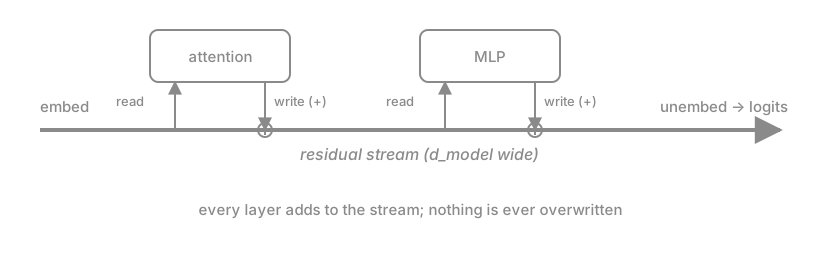
Each block reads the stream, computes something, and writes the result back as a sum:
\[x_{\ell+1} = x_{\ell} + \mathrm{Attn}(x_{\ell}) + \mathrm{MLP}(x_{\ell})\]Nothing is overwritten, so the stream behaves like a shared bus: an early head can write a feature that a much later MLP picks up, and the two communicate without any layer in between knowing about it. It also means you can decompose the final logits into a sum of contributions from every block — which is exactly what makes mechanistic interpretability tractable.
Short explainer video: Residual stream, in 60 seconds
Tags: transformers, interpretability, deep_learning, machine_learning